The Science & Safety Basics
Understanding how your body reacts to the deep is the first step to becoming a confident first time diver.
- SCUBA is an Acronym: It stands for Self-Contained Underwater Breathing Apparatus.
- The Number One Rule: Never Hold Your Breath: Compressed air expands as you ascend; constant breathing allows it to escape naturally.
- Equalizing is Essential: You must “pop” your ears to balance the increasing water pressure as you go deeper.
- 3D Movement: You can move up and down just by using your lungs—inhale to rise, exhale to sink.
- Nitrogen Absorption: Your body absorbs nitrogen under pressure, which is why we do “safety stops” to let it off-gas.
- Ascent Rate: Always ascend slower than your smallest bubbles to prevent decompression sickness.
Life Under the Waves
What happens to your senses once you’re submerged? It’s a different world down there.
- Colors Fade: Water absorbs light. Red is the first to go, making things look blue/green unless you have a torch.
- Sound Speed: Sound travels 5x faster in water, making it hard to tell which direction a noise is coming from.
- Magnification: Light refraction makes fish look 33% larger and closer than they actually are.
- Calorie Burn: Diving can burn 300–600 calories per hour as your body works to stay warm.
- Green Blood: Without red light waves, a small scratch at 60 feet will look like you’re bleeding green fluid!
The Gear and the Etiquette
First time divers should know the following things about diving gear and some ground rules:
- Universal Fins: Most scuba fins are symmetrical; there is no “left” or “right” foot.
- The “Spit” Trick: Saliva is a natural defogger for your mask (though commercial gels work too!).
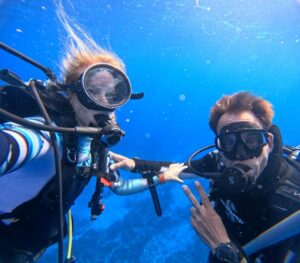
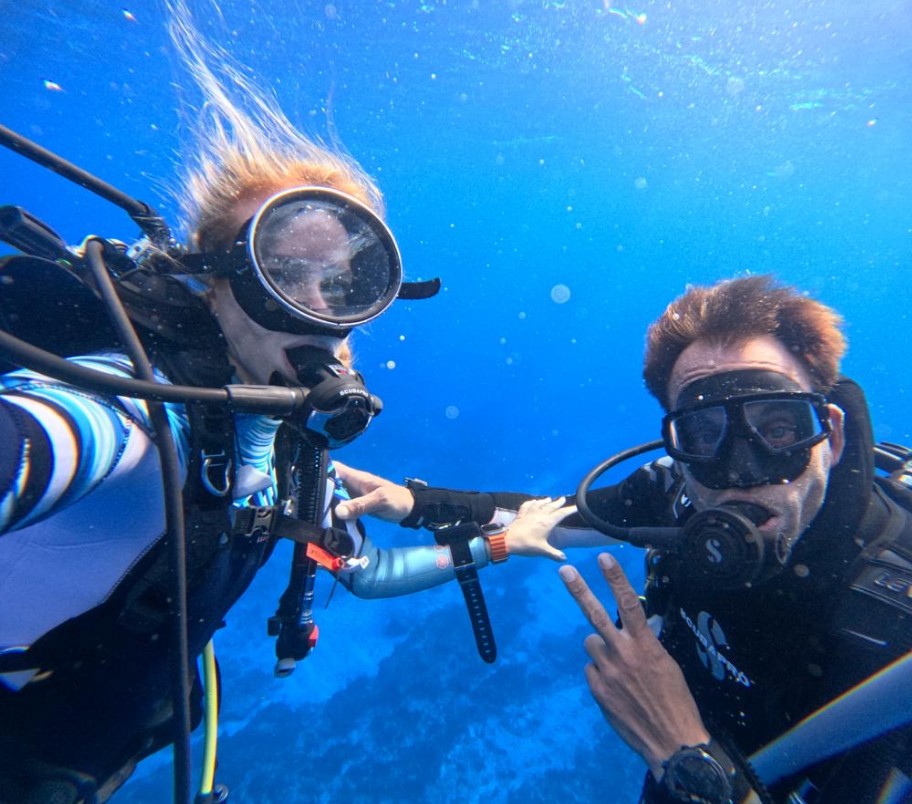
- The Buddy System: You never dive alone. Your buddy is your safety net and your co-explorer.
- Look, Don’t Touch: Coral is an animal. Touching it can destroy decades of growth in seconds.
- Bubbles are Meditative: The rhythmic sound of your breathing is one of the most relaxing parts of the sport.
Fun & Quirky Realities
A few more random first time diving factoids:
- Sharks are Shy: Most Bahamas sharks are terrified of your noisy bubbles and will swim away immediately.
- Depth Limits: Beginners are generally capped at 18 meters (60 feet)—the sunniest part of the reef!
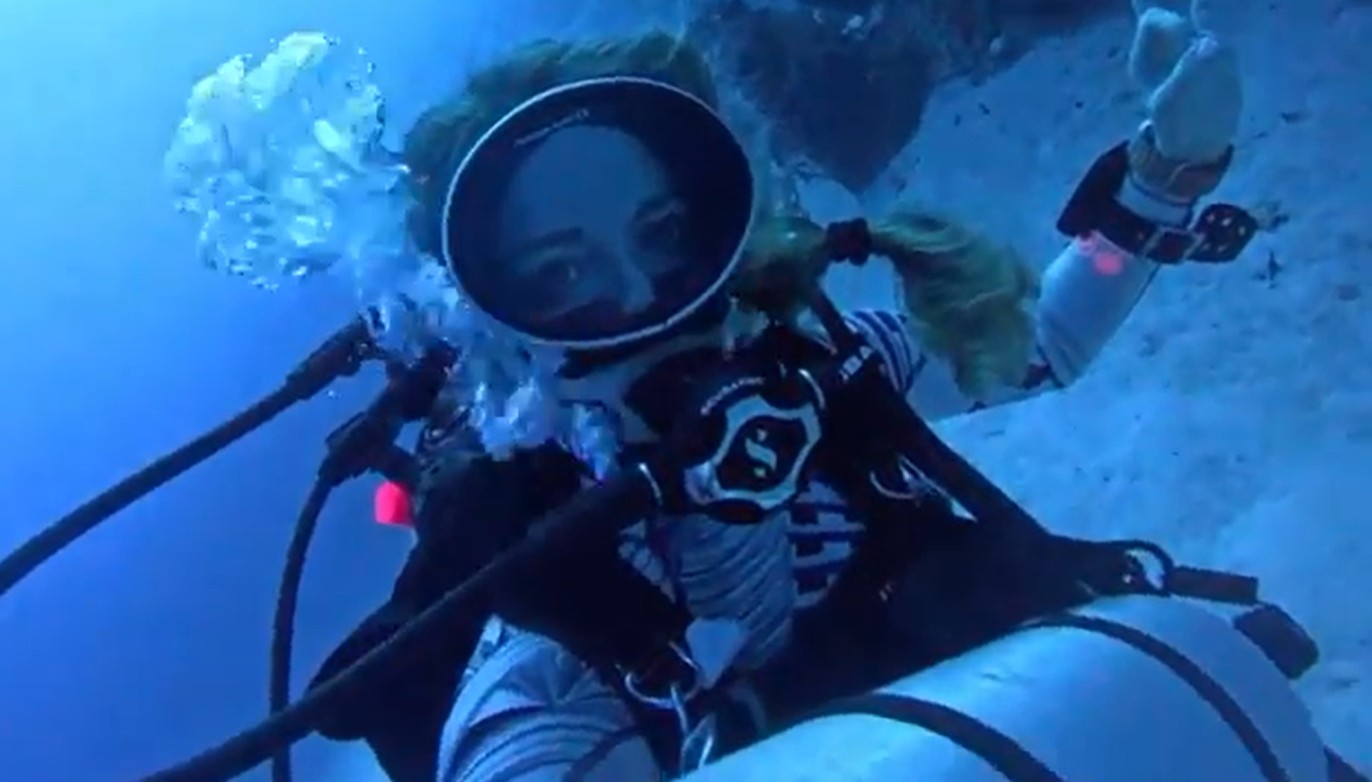
- Hand Signals: Since you can’t talk, you’ll learn a universal language of signs to communicate.
- Dive Hunger: The “post-dive” appetite is legendary. Be ready for a big meal after your session!
Ready to Start Your Adventure?
Scuba diving is a way to see the 70% of the planet that most people never experience. At Only Blue Diving, we take pride in our small groups and personal touch.
Ready to see the blue for yourself? Book your first dive with us at Columbus Isle!
Frequently Asked Questions: The Realities of First-Time Scuba Diving
While scuba diving is an incredibly rewarding pursuit, it is fundamentally an extreme sport that takes place in an environment where human beings cannot naturally survive. Life-support equipment and strict adherence to physics are required. To prepare you for the physical and psychological realities of your first dive, we have compiled this detailed, safety-focused FAQ.
1. What are the primary physiological risks of scuba diving, and how are they mitigated? The two most significant risks in recreational diving are barotrauma (pressure-related injuries) and Decompression Sickness (DCS, or “the bends”).
-
Barotrauma occurs when the air spaces in your body (lungs, sinuses, middle ear) fail to equalize with the surrounding water pressure. The absolute mitigation for lung barotrauma is the golden rule of diving: never hold your breath.
-
Decompression Sickness occurs when dissolved nitrogen gas in your bloodstream forms bubbles as you ascend. This is mitigated by strictly adhering to depth limits, dive tables (or computers), and ascending at a rate no faster than 30 feet (9 meters) per minute, always concluding with a mandatory safety stop.
2. Are there strict medical contraindications that will prevent me from diving? Yes. Because diving subjects your body to increased ambient pressure and physical exertion, certain medical conditions absolutely disqualify you from participating.
These include, but are not limited to, active asthma or a history of spontaneous pneumothorax (collapsed lung), severe cardiovascular disease, epilepsy, and insulin-dependent diabetes (though some exceptions exist with strict medical clearance). You will be required to complete a comprehensive medical questionnaire before entering the water. If you answer “yes” to any medical condition, you must obtain written clearance from a physician.
3. What happens if I experience a panic attack underwater? Panic is arguably the greatest danger a diver faces. It overrides training and logic, often leading to rapid, breath-held ascents, which can cause fatal lung over-expansion injuries. If you feel anxiety building underwater, you must immediately employ the “Stop, Breathe, Think, Act” protocol.
Stop swimming, establish physical contact with your instructor, focus entirely on taking slow, deep, continuous breaths, and allow your heart rate to settle before making any further decisions. Instructors are highly trained to recognize the early physiological signs of panic (such as wide eyes and rapid breathing) and will intervene physically to stabilize you.
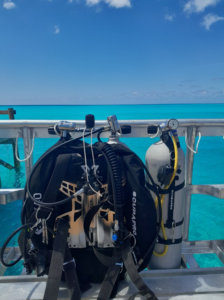
4. How is equipment failure handled during a dive? Modern scuba apparatus is heavily regulated, rigorously tested, and operates on a system of redundancy. Catastrophic, spontaneous equipment failure is exceedingly rare. If your primary regulator (breathing mouthpiece) fails, you are equipped with a secondary regulator (the “octopus”). Furthermore, your dive buddy is also equipped with a secondary air source. Total out-of-air emergencies are almost exclusively the result of diver error (failing to monitor the submersible pressure gauge), not mechanical failure.
5. What are the consequences of failing to equalize my ears? As you descend, the water pressure pushes inward on your eardrums. You must manually force air into your middle ear via the Eustachian tubes to equalize this pressure.
If you fail to do this, the pressure differential will cause severe pain and can eventually rupture the tympanic membrane (eardrum), leading to vertigo, hearing loss, and infection. If you cannot equalize your ears, the dive must be aborted immediately. There are no exceptions to this rule, and you must never “push through” ear pain.