First of all, what are corals? They are animals! Yes — very small ones, but animals nonetheless, belonging to the same family as sea anemones. A polyp is a single individual, and a coral colony is made up of many polyps that all share the same DNA.
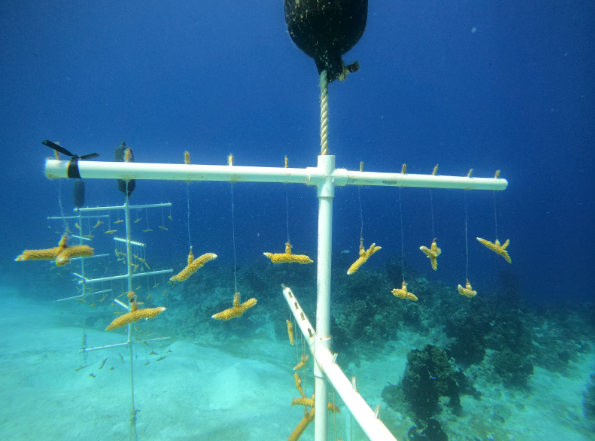
The Fascinating World of Coral Growth
There are many species of coral. Some form branching colonies, others grow in plate-like shapes, brain-like structures, or encrusting forms. Polyps build their coral skeleton out of calcium carbonate (limestone) using elements dissolved in seawater. The colony grows by budding, where polyps divide and produce clones of themselves. This growth is extremely slow — for example, rounded colonies grow only about 1 cm in thickness per year.
The Crisis Facing Coral Reefs
Branching colonies grow faster under favorable conditions (up to 20 cm in a year), but they are also the most fragile when exposed to strong swells and storms.
Unfortunately, coral reefs are under severe pressure, and corals have not been spared. They are highly affected — 50% of reefs have already disappeared or are severely damaged.
Coral Reef Restoration and Nurseries
Many organizations work toward coral reef restoration, and one of the key tools is the creation of coral nurseries.
In practice, this involves identifying a large, healthy mother colony of the species targeted for restoration and collecting a few small fragments, about 5 cm long. These fragments are then placed in a nursery — a protected area away from predators and competitors, offering better conditions for growth. Once the fragments are large enough, they are transplanted back onto the reef, with the hope that they will continue to grow and eventually reproduce sexually by releasing their gametes. Following fertilization, the egg becomes a larva, which will search the reef for a suitable place to settle and transform into a polyp — and eventually form an entirely new colony.
There are different types of nurseries, and all of them require regular monitoring and maintenance.
Our “Tree-Style” Coral Nursery on San Salvador
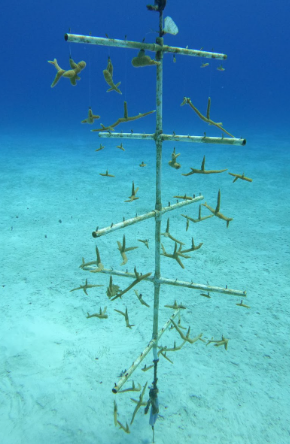
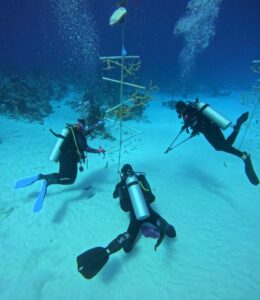
On San Salvador, in partnership with the Perry Institute for Marine Science, we have established “tree-style” nurseries. These structures resemble underwater trees: anchored in the sand at their base and held vertically by a buoy. Across our three sites, we maintain nine nursery trees, each hosting fragments of a branching coral species known as staghorn coral (Acropora cervicornis).
The Critically Endangered Staghorn and Elkhorn Corals
In the Caribbean, both elkhorn coral (Acropora palmata) and staghorn coral (Acropora cervicornis) are listed as critically endangered on the IUCN Red List. Their populations have declined by 90% in the Caribbean since the 1980s, largely due to white band disease, hurricanes, and rising sea temperatures that cause coral bleaching events — the most recent occurring in 2023.
This makes continued restoration efforts absolutely essential!
How You Can Get Involved and Support Restoration
We offer the PADI Reef Rescue Diver course for anyone wanting to learn more about our nursery work and help with maintenance activities. Feel free to contact us to learn more!
If you would like to support our coral restoration efforts, you can contribute by making a donation through the Club Med Foundation: https://clubmedfoundationfriends.com/projets/only-blue-for-reef-2/